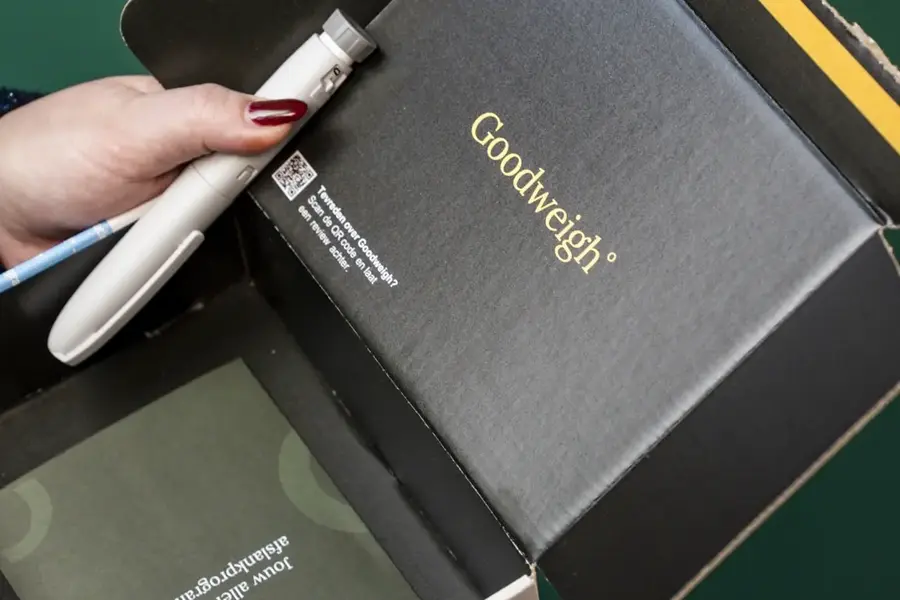
How much weight can you lose with Saxenda?
How much weight can you lose with Saxenda?
Saxenda is a registered weight-loss medication based on liraglutide, a GLP-1 agonist that suppresses your appetite and increases feelings of fullness. But how much weight can you actually lose with it? In this blog, you’ll discover what the studies say, which factors influence your results, and how Goodweigh supports you on your journey to lasting success.
What is the average weight loss with Saxenda?
Randomised clinical trials show that people using Saxenda in combination with lifestyle changes lose an average of 8 to 9 per cent of their body weight over a period of 56 weeks. For someone weighing 100 kilograms, that equates to a weight loss of 8 to 9 kilograms. By comparison, the placebo group in the same study lost an average of just 2.6 per cent. The difference is therefore clinically significant.
A clinical study published in JAMA showed that people with type 2 diabetes also lost a measurable amount of weight with liraglutide, although the average weight loss in that group was slightly lower due to additional metabolic complexity. This underlines that the drug has a broad effect, but that personal circumstances also influence the outcome.
What factors influence your results?
Saxenda does not work the same way for everyone. Starting weight, the presence of comorbidities such as insulin resistance or type 2 diabetes, and how consistently you follow the dosing schedule all play a role. People who follow the titration schedule properly and reach the full maintenance dose of 3.0 mg per day consistently show better results in studies than those who remain on a lower dose due to side effects.
Diet and exercise remain essential. Saxenda is approved as an adjunct to a low-calorie diet and increased physical activity, not as a substitute. Those who combine the medication with mindful dietary choices and regular exercise get significantly more out of the treatment than those who rely solely on the medication.
It is also important to note that Saxenda can cause side effects, particularly during the titration phase. Nausea, vomiting and stomach discomfort are common and are the reason many users choose to slow down the titration process. In the event of severe or persistent side effects, it is advisable to contact a doctor
When do you start to see the effects of Saxenda?
Most people notice a reduction in their appetite within the first two to four weeks. Research shows that liraglutide works via specific GLP-1 receptors in the brain that regulate satiety and influence food preferences, which explains why the effect is noticeable early on in treatment. Visible weight loss on the scales usually follows after four to eight weeks, depending on your starting point and the extent to which your lifestyle changes.
It is important to remain realistic in the initial phase. The titration schedule takes five weeks to reach the full dose of 3.0 mg. Read more about the Saxenda dosing schedule if you want to understand exactly how this works in practice.
Is weight loss with Saxenda rapid or gradual?
Saxenda induces gradual weight loss, not a dramatic reduction in a short time. That is also exactly what is clinically desirable. The guideline for responsible weight loss is 0.5 to 1 kilogram per week. With Saxenda, this often proceeds slightly more slowly, particularly in the first few months whilst the dosage is being built up. This gradual pace makes it easier for the body to sustain the change and reduces the risk of muscle loss.
Comparative research shows that, in a direct comparison, semaglutide (Ozempic/Wegovy) results in slightly greater weight loss than liraglutide (Saxenda). If you’re curious about the differences, read more about the difference between Saxenda and Ozempic or view the broader comparison of GLP-1 medications.
What is the maximum weight loss possible?
In the SCALE study, over a third of participants lost more than 10 per cent of their body weight, and a smaller group lost as much as 15 per cent. However, these are outliers, not the norm. The maximum achievable depends heavily on individual factors: how long you use Saxenda, how your body responds to liraglutide, and to what extent you change your lifestyle.
Long-term research shows that the combination of GLP-1 medication and exercise is more effective in the long term than medication or exercise alone. This enables sustainable weight management, even after tapering off the medication, provided the right habits have been established.
Experiences of Goodweigh users with Saxenda
Users who follow Saxenda via Goodweigh regularly report that the first few weeks take some getting used to, particularly due to nausea during the build-up phase. Once the maintenance dose is reached, this subsides for most people and daily use becomes routine. Weight loss progresses steadily for most users, with good weeks and weeks where the scales show less movement. This pattern is normal and is no cause for concern.
How does Goodweigh help maintain weight loss?
Prescribing Saxenda is one thing, but lasting results require more. Goodweigh supports you with online consultations, coaching and regular follow-ups. This support not only helps you use the medication safely, but also to integrate the lifestyle changes that make the results sustainable. If you’re unsure whether Saxenda is right for you, you can first check whether you’re eligible for Saxenda via a short questionnaire.
What can you expect from Saxenda?
Saxenda is not a miracle cure, but it is a clinically proven medication that makes a substantial difference when used correctly. A realistic goal for most users is between 5 and 10 per cent weight loss over the first year of treatment, with variations above and below this range. What you actually achieve depends on how you use the medication, the support you receive and how much effort you put into changing your lifestyle. Read more about how Saxenda works if you want to better understand how the medication works before you start. Always discuss with your doctor whether Saxenda is suitable for you, especially if you have other medical conditions or are taking other medications.
Referenties
- Pi-Sunyer, X., Astrup, A., Fujioka, K., Greenway, F., Halpern, A., Krempf, M., ... & Wilding, J. P. H. (2015). A randomized, controlled trial of 3.0 mg of liraglutide in weight management. New England Journal of Medicine, 373(1), 11-22. https://pubmed.ncbi.nlm.nih.gov/26132939/
- Davies, M. J., Bergenstal, R., Bode, B., Kushner, R. F., Lewin, A., Skjøth, T. V., ... & DeFronzo, R. A. (2015). Efficacy of liraglutide for weight loss among patients with type 2 diabetes: The SCALE Diabetes randomized clinical trial. JAMA, 314(7), 687-699. https://pubmed.ncbi.nlm.nih.gov/26284720/
- Lundgren, J. R., Janus, C., Jensen, S. B. K., Juhl, C. R., Olsen, L. M., Christensen, R. M., ... & Torekov, S. S. (2021). Healthy weight loss maintenance with exercise, liraglutide, or both combined. New England Journal of Medicine, 384(18), 1719-1730. https://pubmed.ncbi.nlm.nih.gov/33951361/
- Rubino, D. M., Greenway, F. L., Khalid, U., O'Neil, P. M., Rosenstock, J., Sørrig, R., ... & Wadden, T. A. (2022). Effect of weekly subcutaneous semaglutide vs daily liraglutide on body weight in adults with overweight or obesity. JAMA, 327(2), 138-150. https://pubmed.ncbi.nlm.nih.gov/35015037/
- Silver, H. J., Hughes, J. W., Crofford, L. J., Bhatt, D. L., & Ikizler, T. A. (2023). Effect of the glucagon-like peptide-1 receptor agonist liraglutide, compared to caloric restriction, on appetite, satiety and food preferences. Diabetes, Obesity and Metabolism, 25(9), 2660-2668. https://pubmed.ncbi.nlm.nih.gov/37188932/