Should you choose Ozempic or Mounjaro? Here’s what you need to know
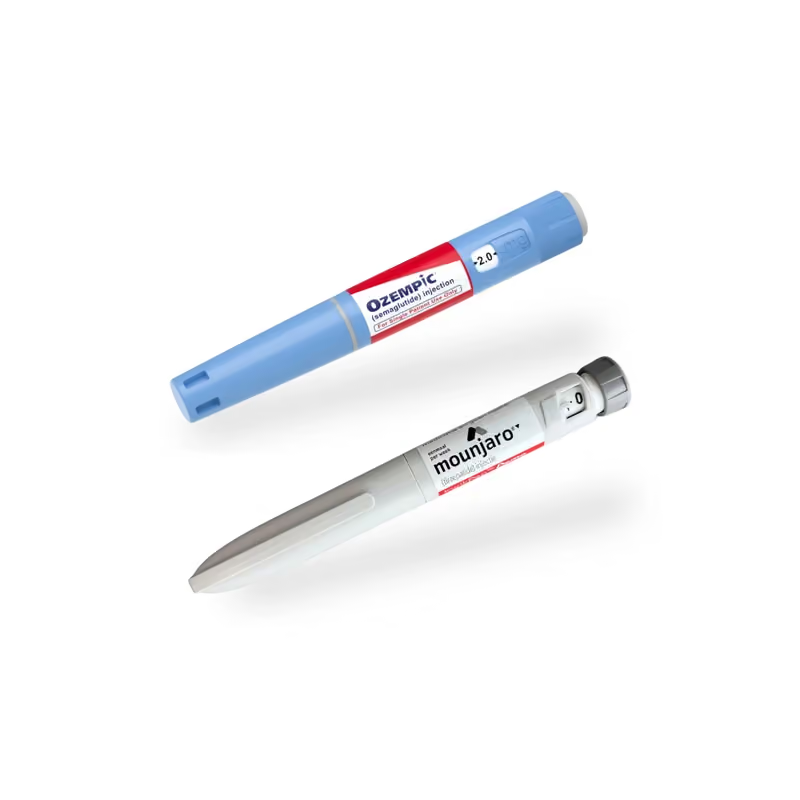
What is the difference between Mounjaro and Ozempic?
Mounjaro and Ozempic are both weekly treatments that aid weight loss, but they differ in key ways: from active ingredient and mechanism of action to effectiveness and availability. A superficial comparison of the two drugs reveals many similarities. For instance, both work via the hormonal system, suppress appetite and are administered subcutaneously (under the skin). Yet they are fundamentally different medicines, each with its own mechanism of action and profile of use. In this blog, you can read exactly where the differences lie, so that you can make an informed choice together with Goodweigh.
What is the difference in active ingredient?
The main difference between the two lies in the active ingredient. Ozempic contains semaglutide, a GLP-1 receptor agonist. GLP-1 (glucagon-like peptide-1) is a hormone naturally produced by the gut after a meal. It suppresses appetite, slows gastric emptying and stimulates insulin release. Semaglutide mimics this hormone, thereby enhancing the feeling of fullness.
Mounjaro contains tirzepatide and acts on two hormonal systems simultaneously: it activates both GLP-1 and GIP receptors. GIP (glucose-dependent insulinotropic polypeptide) is a second gut hormone that also plays a role in fat storage, appetite and energy regulation. By activating both systems simultaneously, Mounjaro has a broader and often more potent effect on metabolism than Ozempic.
For what purpose were these medicines developed?
Both drugs were originally developed for the treatment of type 2 diabetes. Ozempic is officially registered in the Netherlands for diabetes, but in practice is also used for weight loss outside the official indication, which is known as ‘off-label’ use. Weight loss occurred as a side effect in clinical trials, after which doctors increasingly began prescribing the drug to people who are overweight.
Mounjaro followed the same pattern: primarily developed for type 2 diabetes, it has since been approved in several countries for the treatment of obesity.
How do Mounjaro and Ozempic differ in terms of effectiveness?
The difference in mechanism of action has a clearly measurable impact in clinical practice. A study published in the New England Journal of Medicine shows that, after 72 weeks, participants without diabetes lost on average:
- 20.2% of their body weight with tirzepatide (Mounjaro)
- 13.7% of their body weight with semaglutide (Ozempic)
This is a direct side-by-side comparison at the same maximum tolerated dose. Large-scale real-world research also confirms this picture: a study in which more than 40,000 people met the study criteria shows that people on tirzepatide lost more weight significantly more often than those on semaglutide.
Nevertheless, the results depend heavily on personal factors such as lifestyle, adherence to treatment, starting weight and any health issues. Mounjaro and Ozempic can be used at Goodweigh if medically appropriate, always in combination with a personalised support programme.
What is the difference in dosage and titration?
Both medicines are injected once a week, subcutaneously in the abdomen, thigh or upper arm. With Ozempic, the dosage starts at 0.25 mg of semaglutide per week and can be titrated in steps up to 1.0 or 2.0 mg, depending on the product used and the medical indication.
Mounjaro starts at 2.5 mg of tirzepatide per week and is titrated in 2.5 mg increments up to a maximum dose of 15 mg. The dose increments for Mounjaro are larger and the pen formats differ from those of Ozempic. Each pen contains a single fixed dose that cannot be adjusted manually. Both regimens are always administered in consultation with a doctor, so that the dosage is tailored to your response and tolerability.
Is one of the two better tolerated and are there differences in side effects?
The side effects of Mounjaro and Ozempic are largely similar. The most common milder symptoms are nausea, vomiting, diarrhoea and a feeling of fullness, particularly in the first few weeks of treatment or after a dose increase. These are typical effects of GLP-1 activation and tend to subside naturally in most people as the body gets used to the medication. As for serious side effects: the comparative study shows that the total number of people experiencing side effects was similar between both groups, but that serious side effects occurred slightly more frequently with tirzepatide than with semaglutide
Whether one drug is better tolerated than the other varies greatly from person to person. Some people experience more symptoms with Mounjaro during the titration phase due to the larger dose increments; others, however, tolerate it better than semaglutide. Goodweigh takes this into account during the medical assessment: if you are sensitive to side effects, this will be considered when choosing the starting drug and the titration rate.
Which one suits your situation?
Ozempic is the proven, widely available medication with a comprehensive safety profile and years of clinical experience. It is a good first choice for people starting medication-assisted weight loss. Mounjaro is the newer medication with a stronger dual mechanism of action, which in clinical studies leads to greater weight loss on average and is therefore an interesting option for people seeking a more potent effect or for whom Ozempic did not produce sufficient results.
However, the best choice is always a personal one. Factors such as your health condition, any other medication you are taking, experience with side effects and your personal preference all play a role. Goodweigh helps you make an informed decision based on an initial consultation and medical assessment.
Together with Goodweigh, you choose the medication that suits you
You don’t have to figure it out yourself. Goodweigh guides you step by step through the choice between different weight-loss medications, tailoring everything to your goals, health and preferences. A doctor assesses your situation and draws up a personalised treatment plan. This way, you start with confidence, know what to expect and aren’t left to face it alone. Online assessment.
Referenties
- Aronne, L. J., Sattar, N., Horn, D. B., Bays, H. E., Wharton, S., Lin, W. Y., ... & Jastreboff, A. M. (2025). Tirzepatide as compared with semaglutide for the treatment of obesity. New England Journal of Medicine, 392(22), 2031–2044. https://pubmed.ncbi.nlm.nih.gov/40353578/
- Brit Long, Jessica Pelletier, Alex Koyfman, Rachel E. Bridwell, GLP-1 agonists: A review for emergency clinicians, The American Journal of Emergency Medicine, Volume 78, 2024, Pages 89-94, ISSN 0735-6757, https://doi.org/10.1016/j.ajem.2024.01.010.
- Chavda, V. P., Ajabiya, J., Teli, D., Bojarska, J., & Apostolopoulos, V. (2022). Tirzepatide, a New Era of Dual-Targeted Treatment for Diabetes and Obesity: A Mini-Review. Molecules, 27(13), 4315. https://doi.org/10.3390/molecules27134315
- Mounjaro. (z.d.). Mounjaro. A Lilly Medicine. Mounjaro.lilly. Geraadpleegd op 19 maart 2026, van https://mounjaro.lilly.com/
- Ozempic. (z.d.). Ozempic. Ozempic.com. Geraadpleegd op 19 maart 2026, van https://www.ozempic.com/
- Rodriguez, P. J., Goodwin Cartwright, B. M., Gratzl, S., Brar, R., Baker, C., Gluckman, T. J., & Stucky, N. L. (2024). Semaglutide vs tirzepatide for weight loss in adults with overweight or obesity. JAMA Internal Medicine, 184(9), 1056–1064. https://pmc.ncbi.nlm.nih.gov/articles/PMC11231910/